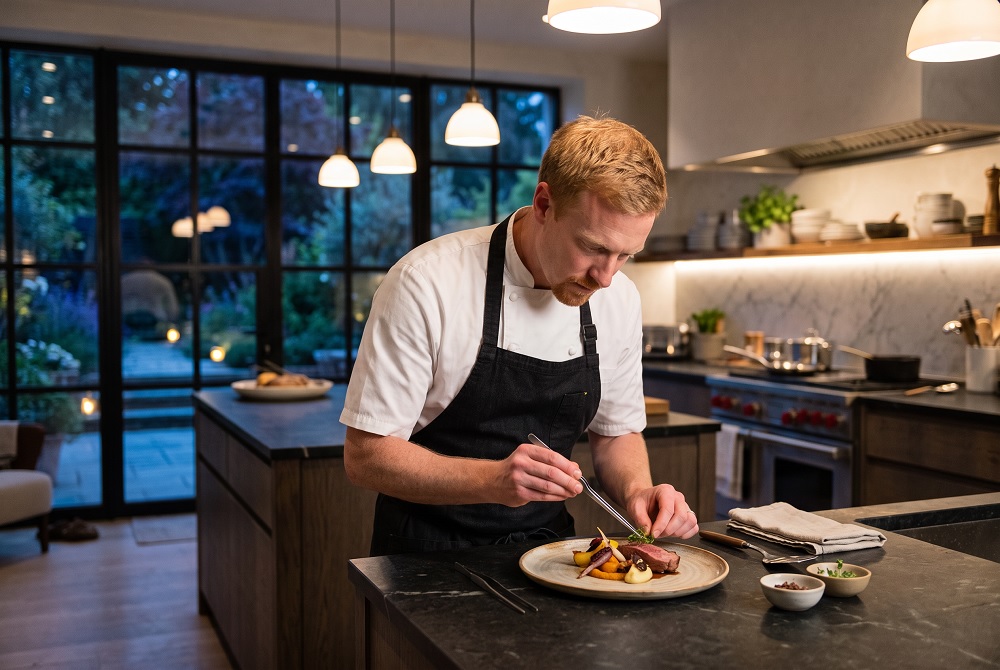
I almost never know what kitchen I’m walking into.
That is the part of private cooking nobody warns you about. A restaurant chef learns one stove, one set of pans and one walk-in fridge, and gets to know them the way you know a car you’ve driven for years. I cook in a different home most weeks. Some kitchens are beautiful and have barely been used. Some have a burner that never quite lights. A yacht galley is its own world again, with drawers that have to latch shut so they don’t fly open when another boat’s wake rolls through.
So my bag has slowly become my kitchen. This is what goes in it. Most of it is cheap, and almost all of it would make a difference in your own kitchen too.
Four Knives, Not Twelve
People expect a chef to unroll a long canvas wrap full of blades. Mine holds four: a chef’s knife, a paring knife, a serrated knife for bread and ripe tomatoes, and a thin flexible knife for fish and trimming meat. Plus a honing steel, because a dinner for ten means a lot of onions.
I would rather have four knives I know by feel than a drawer of ones I don’t. If you are buying one good knife for home, make it the chef’s knife, and hold it in a shop before you pay.
My Own Boards
Two of them. One for raw meat and fish, one for everything else. A surprising number of beautiful kitchens come with a glass or marble board, which looks lovely on the counter and ruins a knife edge in about ten minutes. If yours is one of them, keep it for serving cheese.
An Oven Thermometer
This is the cheapest thing in the bag and probably the most important.
Ovens lie. The dial says 180°C. Inside, it might be 160°C, or 200°C, and the back left corner might be hotter than the front. When I arrive I hang a small thermometer on the middle shelf, switch the oven on, and within fifteen minutes I know what I’m really working with.
If your cakes always sink or your roasts take forty minutes longer than the recipe says, it is very possibly not your fault. Buy a thermometer before you buy a new cookbook.
A Probe Thermometer
A second one, for the food rather than the oven. It ends the guessing with roasts and fish, and it lets me take meat out a few degrees early and let resting finish the job. Home cooks often overcook expensive cuts out of nervousness. A probe costs less than one good steak.
Salt I Trust
I bring flaky sea salt and a fine sea salt. Whatever is in a client’s cupboard might be iodised table salt, which tastes faintly metallic once you use enough of it, or a coarse grinder that takes forever over a pot of soup for twelve. Seasoning is the one thing I can’t afford to be inconsistent about.
A Jar Of Tasting Spoons
Twenty or so teaspoons, clean ones going in, used ones going straight into a separate pot. I taste everything, constantly, and never with the same spoon twice. It is the habit I most wish home cooks would steal. Taste the sauce before it goes on the plate, not after your guests do.
Masking Tape And A Marker
Not glamorous, but I wouldn’t work without them. In someone else’s fridge, surrounded by their yoghurt and leftovers, everything I bring gets a label: what it is, which course it belongs to. A strip of tape on a cupboard door becomes my running order for the evening, with times written down the side. Nobody has to ask me what’s next. Neither do I.
Limes, Always
This one comes from my time cooking in Thailand. There are always a few limes in the bag, and a fine grater to go with them.
Thai cooking taught me that a dish which tastes flat almost never needs more salt. It needs something sour and fresh. A little lime zest over a rich braise, or a squeeze into a dressing just before serving, can bring a heavy dish back to life. I grew up on the deep, slow cooking of Munich, and those dishes are wonderful. They are even better with a bit of brightness at the end.
What Stays At Home
Big equipment, mostly. No stand mixer, no water bath, no gadget that does one clever thing. The more a cook depends on special machines, the more stuck they are when the machines aren’t there, and in my job they usually aren’t. A good pan, a sharp knife and a reliable oven temperature get you most of the way.
The Point Of The Bag
Nothing in it is secret, and none of it is expensive. What it gives me is control in a room I have never stood in before. As a private chef in Toronto, I can walk into a stranger’s kitchen at four in the afternoon and serve a calm, confident dinner at seven, because the things that matter most came in with me.
You don’t need a knife roll to cook well at home. But an oven thermometer, one good knife, salt you like and a habit of tasting everything will change your cooking more than any recipe will.